

Akrites was founded in June 2026 to help get large numbers of security vulnerabilities discovered with AI assistance fixed upstream in an efficient, effective, and respectful way. To meet this challenge we’re building both automated and human systems to process thousands of vulnerability reports today, and potentially hundreds of thousands in the future. Along the way we’ve had to create new tools, develop relationships across the ecosystem, and keep empathy for the upstream maintainer at the forefront of everything we do.
Processing a report can mean many different things: some reports come in to our pipeline incomplete; some will be duplicates; we will learn that some have been fixed between the time the issue was discovered and our reporting is ready; we also know that some projects are overwhelmed and may not want large numbers of low-severity reports. Ideally by providing high-quality, vetted data to the upstream the majority of these reports will get filed with the maintainers and fixed for all consumers of the project.
The Systems We’re Building
The automated part of our process is a pipeline called The Akrites Pipeline (TAP). TAP accepts vulnerabilities from member organizations and partners via an API, enriches reports with data like a vulnerability type classification (e.g. CWE, CVSS) and relevant programming languages, performs an independent severity assessment with frontier models, deduplicates reports, and prepares initial patches. Once all of that is done, reports are then handed off to the Akrites Security Incident Response Team (SIRT) for manual review and the final upstream reporting refinement and decisions.
Our SIRT team manages the human evaluation of reports, upstream reporting, embargoes, and other coordinated disclosure tasks. Most SIRT members are security engineers who perform human evaluation of reports that have gone through TAP already, then help file upstream reports. There are also folks who manage coordinated disclosure, as well as leadership.
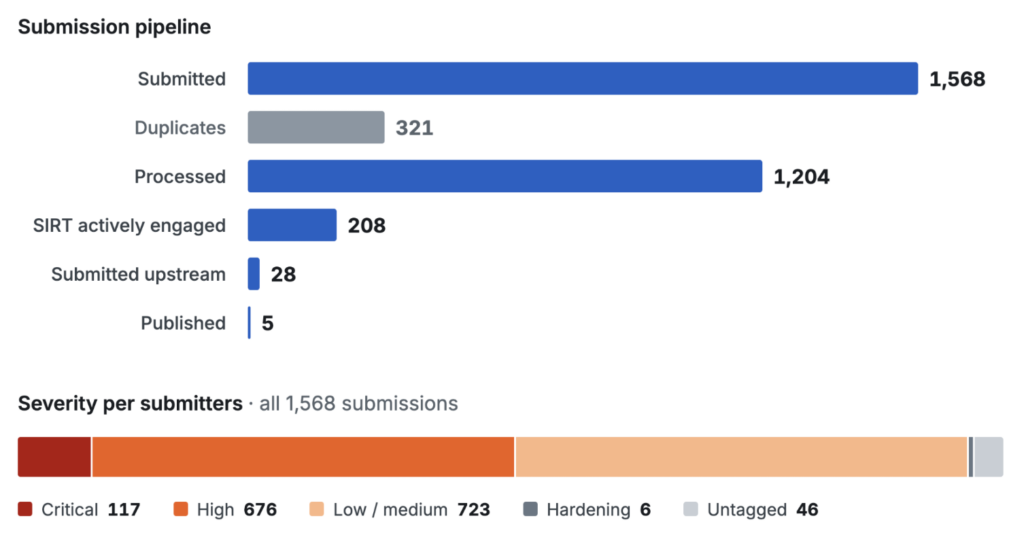
The Beginning in Numbers
Here’s what our processing metrics look like as of November 15, 2026:
Challenges
Respectful Reporting
We want to be as respectful as possible to maintainers. This raises some difficult questions, like what is the appropriate ratio of automatable and manual due diligence before reporting upstream? One challenge, given the high volume of findings, is the risk that we overwhelm maintainers who are already over-burdened. From what we can observe, and have been told, that describes the current situation for a lot of maintainers. Another challenge is that allocating manual resources to reviewing and upstreaming high-quality but low-severity reports takes Akrites resources away from work on higher severity issues. Of course, if certain maintainers want to see all reported issues regardless of severity we can make that happen, but if we only have resources to manually review the higher-severity findings, we risk sending low-quality reports to maintainers, an outcome we’re hesitant to produce.
For the moment we’re certainly prioritizing critical and high-severity issues. Until we’ve got more information about how many critical and high-severity findings need remediation, more experience with our resource usage rate, and feedback from maintainers, we’re probably going to hold off on processing lower severity reports. We’ll see how things go.
LLMs Are Not Great At Severity Assessment
If you just ask a single LLM for a severity assessment, even a leading frontier LLM, our experience is that it will usually overestimate severity, which comes at a real cost to maintainers and downstream defenders. This is probably due to a combination of limited capability and context. How the software is being deployed, what data it interacts with, and what systems it connects to are data points LLMs (and most humans) frequently misinterpret or do not have access to. This leads to a mismatch in severity assessments, which leads to confusion for all interested consumers.
Akrites has skilled humans review reports, including severity assessments, before they are upstreamed. However, we rely on automated AI severity assessments for a first round of triage and prioritization because AI certainly has the advantage when it comes to scaling. It’s not realistic to have humans immediately perform accurate severity assessments on thousands of reports.
In order to get a better result than what we’d get from just asking a single frontier LLM agent, we’ve been hard at work building a system that adds as much context as possible and then uses a system of subagents to critically evaluate an initial agent’s assessment.
No matter how good a job we do, the system will make mistakes due to varying degrees of context and imperfect training and orchestration. Humans aren’t exactly infallible either. Perfection is not the standard the automation is up against. This is a tough problem to solve! To make sure our severity evaluation agents are doing a good job we’ve built a test suite that runs whenever we make changes to the system.
More to come
Akrites is just getting going! We’re actively engaged across numerous upstream projects and with downstream consumers today. The hard work of getting through the backlog of outstanding scans is our current priority as we keep an eye to the future of more broadly accepting reports from the ecosystem. If you’re an upstream maintainer, we will approach you as vulnerability reports are filed against your project. We will follow your project’s documented processes and rules around vulnerability disclosure. If we haven’t contacted you yet, and you’re interested to learn more about how we can work together, please let us know! If you are interested to learn more about how you could join our effort, you can learn more by following this link.
Our Members
Our members make our work possible. Without their hard work, expertise, and upstream open source expertise, Akrites would not be possible. We’d like to thank our Premier members: AWS, Anthropic, Bank of America, Chainguard, Cisco, Endor Labs, Ericsson, Google, Hitachi, IBM, JPMorgan Chase, Microsoft, NVIDIA, RapidFort, Red Hat, Samsung, Sonatype, and our General members: Deloitte, HeroDevs, Palo Alto Networks, Vodafone, and Zscaler.